
Notes from the Hills: What's that Village?
A visit with GiveDirectly to rural Musanze, among bananas, people, and new possibilities.

Turn phone calls into completed transactions. Pindo is a technology company specialising in Voice AI.
Much like in other parts of this country, a lot has changed in the northern district of Musanze, known for its massive volcanoes which form the Virunga National Park and for its most famous inhabitants, the mountain gorillas once studied and celebrated by primatologist Dian Fossey. The last time I was here, I had come to deliver a gift (the content of which I shall not disclose just yet for reasons I shall not disclose either) to a wonderful person. The only thing I remember doing is looking for Crema café, which had already re-located, and going there. I skimmed through their menu quickly, ordered a chicken wrap and an Americano, enjoyed it and the new space, before returning to Kigali. It was a short, one-day trip.
But this time circumstances offered your writer more time to see and explore what this part of the world now has to offer.
I used to live in Musanze for two years in the early twenty-tens. Back then I was running a citizen science literacy project with the Karisoke Research Centre of the Dian Fossey Gorilla Fund. So this is not an unfamiliar place to me.
For Rwandans, of course, Musanze is also known for many other things. At the top, it’s the Kinigi Irish potatoes. Reddish, starchy, with thin, smooth skin, they are an essential vegetable in any local kitchen. And then there is the cold weather. Musanze is cold, and that is not a secret. But you get used to it once you live here. And then you also learn that it’s not as bad as advertised — and that at least the weather can be consistent almost always. Even when it rains, it rarely rains for long.
I.
I spent much of this past Monday in a remote village called Kinkware. It’s just across the border where Musanze meets Nyabihu district in the north-western part of Rwanda.
I was picked up in town by a group of friends from GiveDirectly, a nonprofit working to eradicate poverty by sending unconditional cash transfers to families. I have followed and been a keen observer of their work since around 2018, when I first came across reports about education and the breadth of impact poverty and malnutrition can have on learning and educational attainment.
But this week was the first time I saw what that work looks like once it reaches a family.
We drove for about forty-five minutes along the Nyakinama road. The first landmark we passed was the Rwanda Peace Academy of the Ministry of Defence. Further along stood a nicely-built polytechnic college, a project funded by the Chinese government at a cost of roughly fourteen million U.S. dollars.
The road itself brought back memories.
Not far from there lies the Buhanga eco-park, one of those places in Rwanda that feels almost mythical once you step into it. I remember visiting it in early 2016. Tall trees rise straight into the sky, their branches forming a thick canopy that keeps the forest cool even at midday. Moss grows on old stones. Paths twist slowly between roots and ferns. For centuries, according to local history, this was a sacred forest where kings came for rituals and reflection.
Even driving past it again brought back a quiet sense of familiarity.
Soon the road narrowed, and the houses became more scattered. Banana trees appeared almost everywhere, their large leaves moving slowly in the wind. Hills rose in layers of green around us. And eventually we reached a small trading centre.
It was market day.
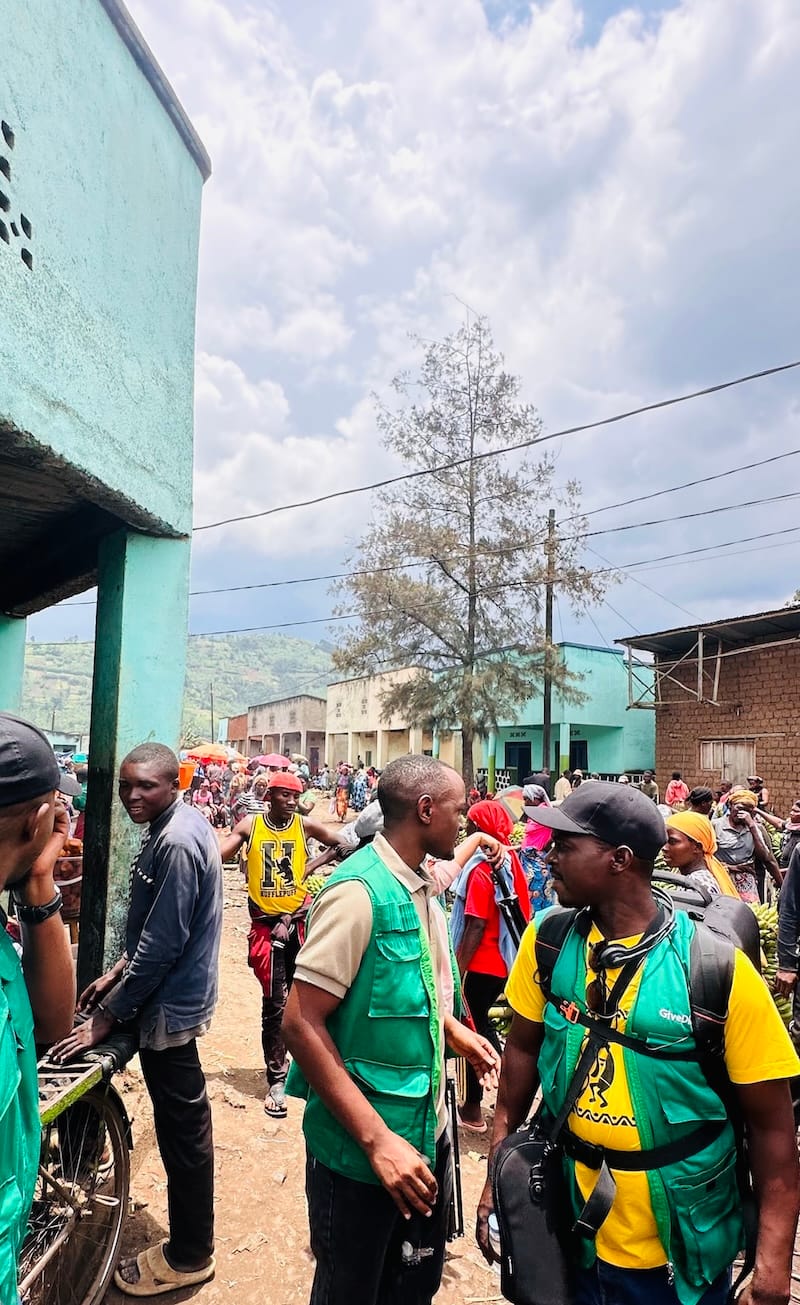
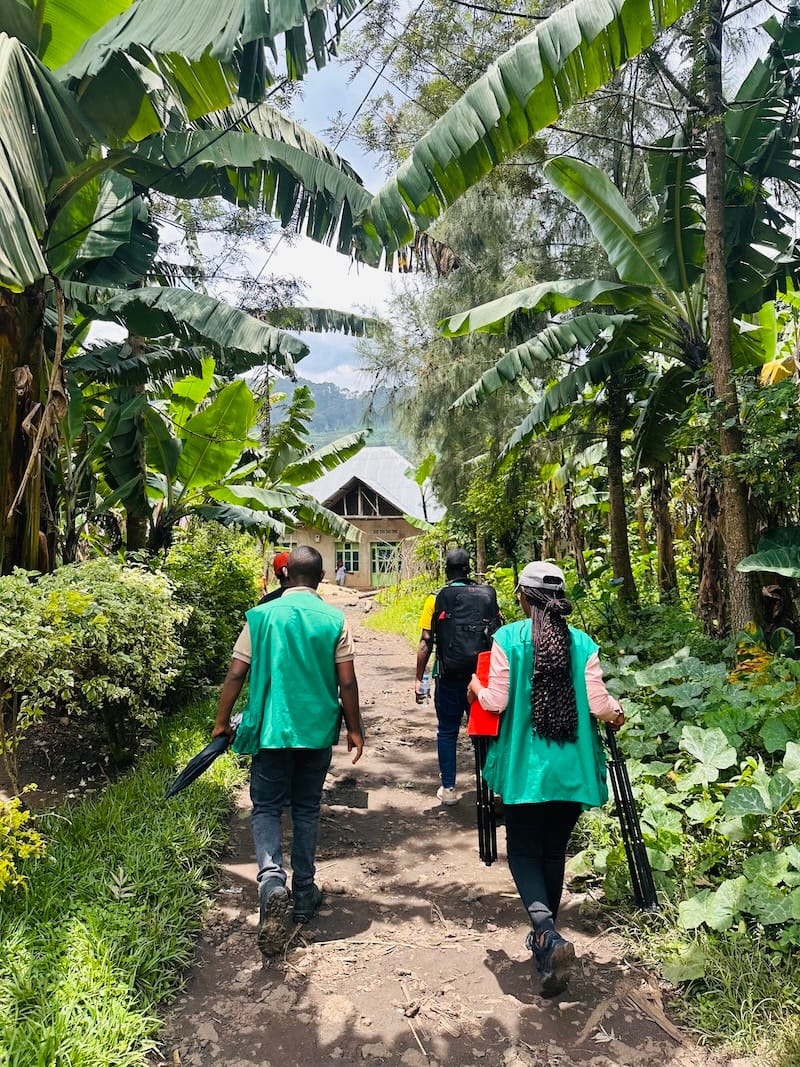
People moved in every direction; some buying, some selling, others simply standing in small groups. Photographs by the author for The Kigalian.
Large piles of matoke lay on the ground, stacked in thick green clusters. People moved in every direction; some buying, some selling, others simply standing in small groups talking about things that did not concern visitors passing through. I saw very few children (it’s school day), they sat nearby watching the commotion while a few men carried bunches of bananas balanced carefully over their shoulders.
There was little sign of the famous potatoes of Musanze here. Bananas seemed to dominate everything. I had never seen it like this in this part of the north.
From there we left the vehicles and continued on foot towards the village where we would meet a few of the families.
The path wound between small homes and gardens. Banana trees grew so close together that their leaves sometimes formed a kind of corridor above the path. In some compounds you could see goats tied to wooden posts. In others, chickens scratched quietly in fenced corners of the yard. At some point, children were returning from school, still in their uniforms, some pausing to look at the unfamiliar group of visitors walking past. Neighbours passing along the path greeted us each time we crossed them, the way people do in villages where strangers rarely pass unnoticed.
The hills stretched out in the distance, quiet and green. The sky suggested rain, but I do not remember seeing a single drop fall.
II.
The household we visited belonged to a man I will call Pio, to protect his privacy. He looks young, perhaps in his early thirties, though in places like this it can be difficult to guess a person’s age with precision. He is a father of four.
When we arrived, Pio was about to feed a few piglets behind the house, livestock he had acquired after receiving the cash transfer. “I was going to feed them,” he told one staffer, “but I am happy to chat with you first.”
At one point two of the piglets slipped through an opening in the small fence and began wandering toward the path. Pio excused himself and ran after them, lifting each one gently and returning them to the enclosure before resuming the conversation as if nothing unusual had happened.
We spoke for a while in front of the house. Later he led us behind the compound to show us the animals he now keeps. A cow stood tied beside a small wooden structure, quietly chewing grass in the afternoon light.
Before receiving the money, Pio’s wife supported the family by selling tomatoes.
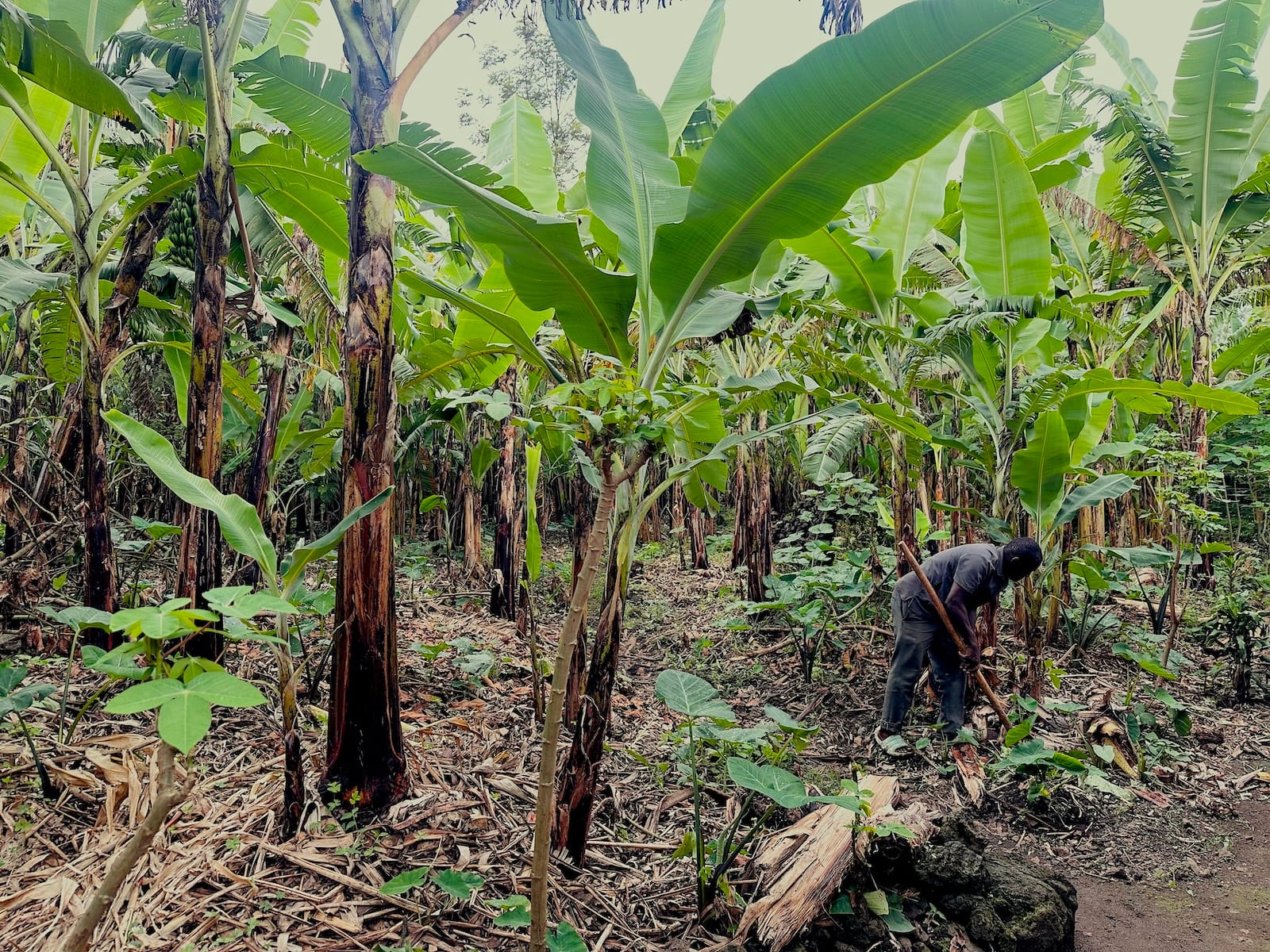
Now their income mainly comes from selling green bananas grown on a small plot of land they were able to purchase. The bunches hang thick and heavy in the garden, the bright fruit forming large clusters beneath the leaves.
At one point Pio mentioned that before the transfer arrived he had borrowed money and spent several nights worrying about how he would repay it. For a time, he said quietly, sleep had become difficult.
The yard was lively.
Children moved around constantly, sometimes playing, sometimes watching us with curiosity. His wife had just returned from the market and welcomed us warmly, the way many rural families in Rwanda receive visitors: quietly, but with unmistakable hospitality. At one point she was chasing their four-year-old around the yard, insisting he should keep his sweater on as the clouds gathered above the hills. The boy protested with the stubbornness only small children seem capable of.
For Pio, the transfer he received (roughly a thousand and one hundred U.S. dollars) represented something much larger than the number itself.
It allowed him to buy land. It also allowed him to invest in livestock. And it allowed his family to imagine stability in a way that might not have been possible before.
“This was such a blessing to our family,” he said.
I have heard many people utter similar words before. But hearing Pio say it did not invite doubt. The sincerity was visible — not only in the way he spoke, but in the decisions he had made since receiving the transfer. Two of his children returned from school while we were there, full of energy and life, running through the yard. Of course, to be fair, there are still challenges ahead. But listening to him tell his story, and speak quietly about his plans for the future, made the possibilities feel very real.
And this was only one household among three hundred families in the area who had received similar transfers. Across the country, GiveDirectly says it has supported more than thirty-four thousand five hundred recipients since May 2023.
III.
At another point I found myself wondering something I did not have time to ask him. What does leisure look like for someone like Pio?
When the work of the day is done, after feeding the animals, tending the garden, helping the children, what does he do with his free time? Does he go for a walk through the hills? Does he visit neighbours and sit outside talking over a drink at a small local bar? Does he sometimes wander down toward a nearby river?
For Pio, the transfer he received (roughly a thousand and one hundred U.S. dollars) represented something much larger than the number itself.
We spent some time together, but I wasn’t going to ask him all of that.
But even in the time we spent there, one thing felt clear. This was a man whose future now looked less uncertain than it might once have been — for himself, for his children, and for the family he is raising with a very warm and hospitable wife.
For years I had read the reports and seen the numbers. But numbers alone rarely carry the full story. Standing in Pio’s yard, surrounded by banana trees, livestock, and children running through the compound, made something obvious.
Cash-transfer programs are sometimes dismissed as “free money.” Others argue that development should follow more familiar paths: business, markets, enterprise. But watching Pio describe the choices he had made for his family, it was difficult not to notice something simpler: when people are trusted with resources and allowed to decide for themselves, they often make careful and sensible decisions.
Sometimes that is enough to change the direction of a household. And if it happens three hundred times in one place, the hills begin to change with it.
As I sit now writing, I find myself thinking about Pio’s children, who ran through the yard that afternoon after returning from school. Every difficulty will not disappear, to be fair. But it is easier to imagine a different path for them now; one where they grow up healthy, remain in school, and carry into adulthood possibilities that might once have felt out of reach.
IV.
Rwanda still struggles with high levels of child stunting, something close to a third of children according to national surveys. The consequences reach far beyond height. Stunting is closely linked to poorer health, slower cognitive development, and lower educational attainment. In other words, it quietly shapes the limits of what a child may later achieve.
Standing in Pio’s yard that afternoon, watching his children run through the compound, it was difficult not to think about that reality. When families gain the stability to feed their children well and keep them in school, the long-term consequences extend far beyond a single household. They shape the kind of society that emerges a generation later.
When we finally left, we walked back toward the vehicles and drove into town. Later we shared a meal (pilau at Silverbacks, if you ask), overlooking Musanze and its volcanoes before parting ways and returning to our ordinary week.
Have something to say about this story? Message the editor or write in the comments section below.